Accidents happen in the home and discovering your cleaner broke something can be stressful. The best first step is to tell the cleaner or the cleaning company straight away and take clear photos of the damage. Most breakages are resolved quickly through a calm conversation about repairs or a discount.
First, what to do on the day
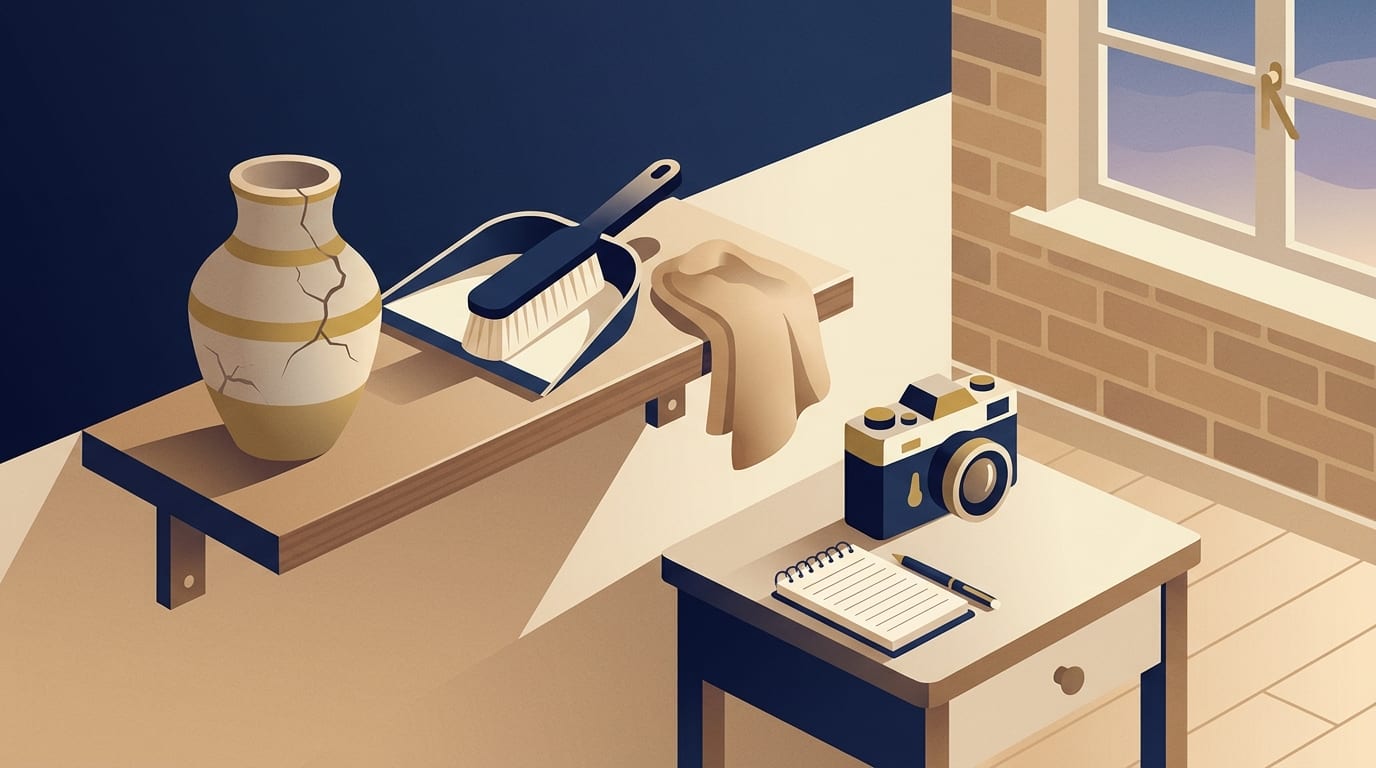
When you discover that a cleaner has broken something in your home, the most important thing is to stay calm and assess the situation safely. Leave the broken item exactly where it is if it poses no immediate danger to children or pets. Take clear, dated photographs of the damage before you attempt to clear away any scattered pieces. These photographs serve as a vital record of exactly what happened and how the breakage was left.
If the cleaner is still working in your property, approach them immediately and ask what occurred. Keep your tone polite and factual, as accidents are rarely deliberate and the cleaner is likely to be feeling highly apologetic. A calm conversation at the time of the incident is the easiest way to establish the facts without an argument.
If you only discover the damage after the cleaner has locked up and gone home, you must report it on the same day. Send a written message or an email so that you have a clear timeline of when you raised the problem. State plainly what is broken and attach the photographs you have taken.
Do not throw the broken item in the bin straight away. Gather any shattered pieces or broken parts safely and keep them in a sturdy box. The cleaner, their agency or their insurance provider might need to inspect the item before they agree to pay for a repair or a replacement.
Follow these exact steps to protect your position when you discover a breakage:
- Take clear photographs of the broken item from multiple angles.
- Photograph the surrounding area to show where the accident happened.
- Gather the broken pieces safely and store them in a box.
- Contact the cleaner or the company office on the same day.
- State the facts of what is broken without making angry accusations.
- Ask how they normally handle accidental property damage.
Does it matter if the cleaner is self-employed or from a company?
How you resolve a breakage depends entirely on who you hired to clean your home. You must direct your complaint to the right person to get the problem sorted out quickly.
If you use a local cleaning company that employs its own staff, you should report the damage directly to their main office. Raise it with the company rather than asking the individual cleaner to pay. Ask the company for a copy of their formal complaints process and check whether they carry insurance to cover the loss.
An introductory booking agency introduces a cleaner and takes a fee. Raise the damage with the agency office and the cleaner, and ask what the agency's terms say about who deals with it.
If you hire an independent self-employed cleaner directly, you will need to negotiate with them face to face. Ask whether they hold public liability insurance to cover the cost of accidental damage. You can read more about checking whether your cleaner is self-employed before you agree on a financial resolution.
The rules change completely if your cleaner works for you as your direct employee. According to GOV.UK, you are usually the employer of anyone who works in your home if you hire them and they are not self-employed or paid through an agency. As an employer, you must hold employers' liability insurance yourself to deal with accidents.
This table shows the right person to contact and what you should ask them, based on how your cleaner operates.
|
Who you hired |
Who to tell first |
What to ask |
|---|---|---|
|
Cleaning company with staff |
The company office manager |
What is your complaints process and are you insured? |
|
Introductory booking agency |
The agency office and the cleaner |
Will the agency mediate and who pays for the damage? |
|
Independent self-employed cleaner |
The cleaner directly |
Do you hold public liability insurance for breakages? |
|
A cleaner you employ directly |
The cleaner directly |
What happened and are you safe to continue working? |
What the law says about reasonable care and skill
The law offers strong protection when you pay a professional to carry out a service in your home. Under the Consumer Rights Act 2015, a service must always be provided with reasonable care and skill. Citizens Advice states that if a service was not provided with reasonable care and skill, you have the right to ask the trader to put things right.
Whether a particular breakage falls short of reasonable care and skill depends on what happened, and this guide cannot decide that for your case. If you are unsure, Citizens Advice can help.
However, you must be realistic about fair wear and tear when you raise a complaint. If a picture frame was already loose on the wall, or a chair leg was already cracked, a cleaner simply touching it during a normal dusting routine is not necessarily a lack of care. You should never try to blame a cleaner for an item that was already on the verge of breaking.
The options Citizens Advice describes are to ask for the service to be done again or to ask for a discount, so do not assume you are entitled to a brand new replacement.
Understanding this legal baseline helps to keep negotiations calm and realistic. Both the customer and the cleaner benefit from knowing that reasonable care is the standard, rather than expecting absolute perfection in a busy family home.
Asking for a repair, replacement or discount
When a cleaner breaks something, you have a few clear options to resolve the financial side of the problem. Citizens Advice explains that you can ask the trader to do the service again if possible, or you can ask for a discount. If redoing the work is not possible, would take too long or would be very inconvenient, you can go straight to asking for a discount instead.
Any discount or compensation must be agreed directly with the trader before you take action. You might agree a discount on your next bill, or agree that they put the problem right in another way.
If the broken item is expensive but can be fixed, you might ask the cleaner or the company to pay for a professional repair. The Citizens Advice page on home improvements, which is not written for cleaning, notes that a trader should fix the problem within a reasonable amount of time without causing you too much inconvenience.
That page says that if they cannot or will not fix the problem, you can seek a partial or full refund agreed with the trader, and once the amount is agreed the law says you should get your refund within 14 days. This gives both sides a clear deadline to settle the matter and move on.
Always get the final agreement in writing, even if you settle the matter with a friendly chat in the kitchen. Send a short text message confirming the discount you have agreed and the date it applies to. This prevents any confusion about short payments when the next invoice arrives.
Cleaner or company insurance
Some cleaners carry insurance to protect themselves and their customers against accidents. Public liability insurance provides vital cover in case a cleaning business causes accidental injury or property damage. One common example used by insurers is an employee smashing an expensive vase while vacuuming a customer's living room.
Public liability insurance is not described as a legal requirement for a domestic cleaner, but some clients may insist on it before they hand over a key. It is always a sensible thing to ask about before hiring someone new. You can find out more about what insurance a domestic cleaner should have to ensure your property is fully protected.
If you hire a larger cleaning company that employs its own staff, ask about insurance. A business is required by law to have employers' liability insurance if they employ people. Cover for their employees' actions and mistakes depends on the company having this employers' liability insurance firmly in place.
If a company cleaner breaks something, ask the head office to check their policy details immediately. Ask whether the company will settle a small breakage directly or needs to make a claim.
An independent cleaner may or may not claim on their insurance for a small breakage, so ask what they are willing to do and agree the outcome in writing.
Your own home insurance
If your cleaner does not hold public liability insurance, or if they dispute the breakage entirely, you might need to look at your own cover. You will need to read your home contents insurance policy carefully or ask your insurer directly about how they handle accidental damage caused by a hired worker.
Every home insurance policy is different. Check whether your specific policy covers damage caused by a paying guest, a contractor or a domestic cleaner working inside the property.
A claim on your own policy may involve an excess, so ask your insurer in writing how it would treat damage caused by a hired cleaner before you decide whether to claim.
Time limits and getting help
You do not have to rush into a final decision on the exact day the breakage happens, especially if you need time to get a repair quote. Citizens Advice states that you can ask for things to be put right for up to 6 years in England, Wales and Northern Ireland. In Scotland the period is up to 5 years.
Even though Citizens Advice says you can ask for things to be put right for up to 6 years in England, Wales and Northern Ireland, it is best to report the damage as soon as you notice it and agree a solution with the cleaner or company.
If you cannot reach a fair agreement with your cleaner or the company office, you have options for taking the matter further. You might consider using an alternative dispute resolution scheme to help mediate the problem.
If the problem remains completely unsolved and the trader refuses to cooperate or pay the agreed refund, you can contact the Citizens Advice consumer service for further guidance. Keep all your photographs, repair quotes, receipts and written messages as evidence to support your case.
If the problem is not solved, Citizens Advice says to consider alternative dispute resolution or contact the Citizens Advice consumer service.
How to avoid breakages in future
The easiest way to deal with broken items is to prevent the accidents from happening in the first place. Before a new cleaner starts their regular visits, walk them through every room in your home and point out anything that requires special care.
Write a short note of known fragile or highly sentimental items and leave it on the kitchen counter on their first day. Better yet, simply put small delicate items away in a safe cupboard before your cleaner arrives. If an ornament is totally irreplaceable, instruct your cleaner not to dust or clean that specific shelf at all.
Clear away general clutter from the floors, stairs and surfaces so your cleaner can move around safely with their equipment. Trailing vacuum cleaner cords can easily catch on loose items, so keeping the floor clear is the best way to prevent things being dragged off tables.
A written task list helps to set clear boundaries about what should and should not be touched during a visit. A written checklist also helps if you book a one off deep clean, which covers more of the home.
Following these simple habits will drastically reduce the risk of accidents:
- Walk new cleaners through the home and highlight fragile items.
- Put highly sentimental or easily broken items away in cupboards.
- Tell the cleaner to skip specific shelves if they hold valuable ornaments.
- Clear clutter from the floors to prevent trips and snagged cords.
- Provide a written checklist of exactly what should be cleaned.
- Ask the cleaner to leave heavy furniture in place rather than dragging it.
Common questions
Do I still have to pay my cleaner if they break something?
You should still pay for the cleaning work that was carried out properly. You can ask for a discount or a deduction to cover the breakage, but this must be agreed with the cleaner first. Refusing to pay for work that was done properly is likely to make the dispute harder to settle.
Will a cleaning agency pay for the damage?
This depends entirely on the type of agency you use and their specific terms of service. An introductory booking agency takes a fee to find a cleaner, so ask what its terms say about damage. A company that employs its own cleaning staff may handle it through its own insurance, so ask the office.
Can I force a self-employed cleaner to replace an item?
You can ask them to put things right under the Consumer Rights Act 2015. If the problem is not solved, Citizens Advice suggests considering alternative dispute resolution or contacting its consumer service.
What happens if my employee breaks something?
If you directly employ a cleaner to work in your home, GOV.UK says you must hold employers' liability insurance. For anything else about your position as an employer, check GOV.UK.
Next steps to resolve a breakage
Take these practical steps to sort out a breakage calmly and fairly:
- Take clear photographs of the broken item and its exact location immediately.
- Report the damage to the independent cleaner or the company office on the same day.
- Ask the cleaner or the company office if they hold public liability insurance.
- Agree a fair repair, a replacement or a financial discount directly with the trader.
- Move highly valuable or sentimental items completely out of the way before future cleans.
Accidents happen in every busy home, but dealing with an honest and insured professional makes resolving them much easier. When you are ready to hire someone new, you can search our directory to find a house cleaner near you with genuine customer reviews.
Find a top rated house cleaner near you
2,874 house cleaners across the UK, each ranked on their Google rating and the number of reviews behind it. Start with your county: