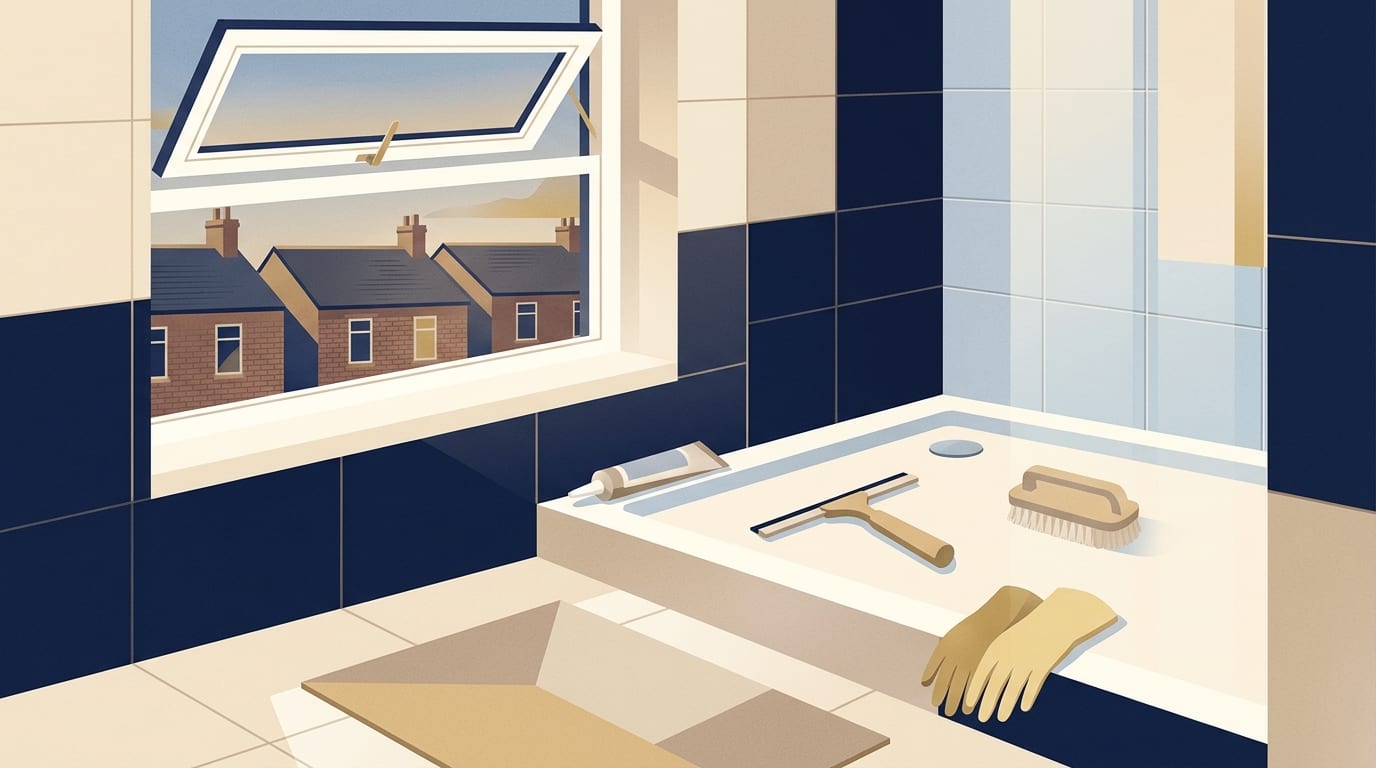
Small patches of black mould on hard surfaces like bathroom sealant and grout are a common problem in damp UK homes. The root cause is usually condensation damp, which happens when moisture from showering, cooking and drying laundry cools and condenses onto colder parts of the building. You can remove very small amounts yourself using an appropriate cleaning product, but cleaning alone will not stop the mould returning if the moisture problem remains.
Why black mould keeps coming back in bathrooms
Condensation damp is the most common form of damp in UK homes. Every time you run a hot shower or bath, a large amount of moisture is added to the indoor air. The same thing happens when you dry laundry indoors on radiators or cook meals on the hob.
When this warm, moist air meets a cold surface like a bathroom wall, window or tile, it cools down quickly and condenses into water droplets. Grout and silicone sealant are prime spots for these water droplets to settle and pool. Because bathrooms experience these moisture spikes daily, the surfaces rarely have enough time to dry out completely.
This constant cycle of dampness creates the ideal environment for black mould spores to grow and spread across the sealant bead. Removing the visible mould from your bathroom surfaces is only half the job. If you simply wipe away the black marks without changing how moisture escapes the room, the condensation damp will continue to form.
What happens if you ignore bathroom mould
Leaving black mould to grow on your sealant and grout is never a good idea. The spores will continue to multiply and spread to other areas of the bathroom as long as the condensation damp remains. What starts as a few black spots on the shower tray sealant can spread to other areas of the bathroom.
Larger areas of mould should only be addressed by qualified professionals, so call a specialist for mould on a ceiling or behind a wall.
Ignoring the problem also increases the risk to your health. The longer you leave the mould to grow, the more spores are released into the indoor air for your family to breathe in. Acting quickly keeps the cleanup job small and protects the people living in the property.
Is it a small patch or a bigger problem
Before you start scrubbing, you need to look at how far the mould has spread across your bathroom. Tenants and occupants can handle very small amounts of mould on hard bathroom surfaces. The guidance gives no size, so if you are unsure whether the patch is very small, treat it as larger and ask a professional.
Larger areas of mould should only be addressed by qualified professionals. Heavy, widespread or recurring mould requires specialist attention to remove safely and to fix the underlying damp issue. You should also call a specialist or a doctor as appropriate if there is mould behind walls or in ceilings, or if anyone in your home suffers from breathing problems.
Damp and mould can produce allergens, irritants, mould spores and other toxins that harm health. The health impacts cover a range of physical and mental conditions.
- Eye irritation.
- Itchy skin or eczema.
- Mental health impacts.
- Respiratory effects, which can cause serious illness.
You also need to check nearby soft furnishings or floor coverings before you begin cleaning. Absorbent materials such as carpets or ceiling tiles may need to be discarded if they become mouldy. Hard surfaces like tiles and glass can be cleaned with an appropriate cleaning product and left to dry completely.
What to wear and how to ventilate
Disturbing black mould releases spores into the air, so you must protect yourself and the rest of your home before you start cleaning. The person removing mould should wear protective equipment to prevent breathing in the spores or getting cleaning products in their eyes.
Put on a mask, gloves and goggles before you open any cleaning products. Keep this protective equipment on until you have finished the job, wiped the surfaces down, and disposed of the wiping cloths.
You must also control the airflow in your home while you work. Keep the bathroom door shut to limit the spread of mould spores into hallways and bedrooms. Leave the bathroom windows open during the cleanup and keep them open long after you have finished.
This ventilation helps limit the spread of spores and helps the bathroom surfaces to dry completely. Drying the area thoroughly is just as important as the cleaning product you apply.
Cleaning mould from grout
Tile grout is a hard surface that catches moisture and soap scum, making it a common place for mould to take hold. You can remove mould from hard surfaces with an appropriate cleaning product designed specifically for the job. GOV.UK guidance on damp and mould states that mould and mildew products should be used in preference to bleach.
You must apply the specialist bathroom mould and mildew remover exactly as directed on the manufacturer label. Check the label for how long the product should stay on the surface. Always keep your mask and goggles on while you wait for the product to work.
Use the method on the product label for working it into the grout, and follow its instructions if it needs to be repeated.
Once the mould is gone, rinse the grout if the label tells you to. The final and most vital step is to leave the surface to dry completely. Wipe the tiles down with a dry cloth and keep the window open until all the moisture has evaporated.
Mould in silicone sealant and when to replace it
Silicone sealant creates a waterproof barrier around your bath, shower tray and sink to stop water leaking into the floorboards. The best solution for mould on silicone sealant is a specialist bathroom mould and mildew remover. You apply it to the sealant bead as directed on the label and wipe it away once it has acted on the spores.
Sometimes a specialist remover is not effective because the mould has set too deeply into the sealant. When the black marks are trapped beneath the surface of the silicone, no amount of surface cleaning will lift them out. Mould that has set this deeply is a sign the sealant needs replacing.
Where mould has set deeply into the sealant, the old silicone needs to be removed and replaced. Removing and replacing the bead is the fix once a remover has failed, and the old silicone has to come out before new sealant goes on.
Using an anti-mould sealant in the first place is the best approach to stop the problem returning quickly. Replacing sealant is a DIY job for some people, while others prefer to hand it over to a handyman or a property maintenance worker.
Why bleach and home remedies are not the best answer
Many people reach for standard household cleaners when they spot black marks in the shower, but these are rarely effective in the long run. Government guidance on damp advises that mould and mildew products are a better choice than standard bleach.
People often try to clean sealant with items from their kitchen cupboards, but these are rarely the best choice. Manufacturer guidance warns against using several common home remedies.
- Standard household bleach may lift surface stains but leaves spores behind.
- Vinegar solutions may help to some degree but do not provide a complete fix.
- Baking soda mixes have the potential to damage the sealant bead.
These DIY mixtures do not kill the mould spores. The marks can come back because the spores are still there. Home remedies also have the potential to damage the sealant bead.
Hiring a cleaner to tackle bathroom mould
When you hire a professional for your home, you need to understand what they will and will not tackle. A regular cleaner will not usually treat mould unless you have agreed this in advance. A standard bathroom wipe down will not remove ingrained black mould or address the condensation damp causing it.
Regular or domestic cleaning is a repeat visit, usually weekly or fortnightly, covering the routine clean of kitchens, bathrooms, floors and surfaces. You can read more about routine tasks in our house cleaning schedule and checklist. A deep clean covers heavy grime and limescale, but ask first whether the cleaner will treat any mould, because heavy mould needs a specialist.
A deep clean goes further than a regular visit, reaching behind the hob, inside appliances, and tackling skirting boards and door frames. It is priced by property size or by the hour and takes much longer. A deep clean does not mean the cleaner will strip out and replace your silicone sealant, so you will need a handyman for that specific job.
The table below shows what you can expect to pay for a professional deep clean compared to a regular weekly visit.
|
Cleaning service |
Typical hourly rate |
Typical total cost |
|---|---|---|
|
Regular cleaning (outside London) |
£13 to £25 |
Priced by hours needed |
|
Regular cleaning (London and South East) |
Higher than outside London |
Priced by hours needed |
|
Deep clean (one bedroom) |
£25 to £45 |
From £180 |
|
Deep clean (four bedrooms) |
£25 to £45 |
£400 to £600 or more |
These are typical 2026 ranges, not quotes, and local prices will differ based on the condition of your home. You should always ask for a written task list so your expectations match what the cleaner plans to do.
Stop it returning
Removing the mould from your grout and sealant is a temporary fix if you do not change the conditions in your bathroom. Condensation damp will continue to form every time you shower unless you improve the ventilation. Showering, drying laundry and cooking add significant moisture to indoor air, and this moisture needs a clear escape route.
Kitchens and bathrooms should have working extraction to pull the moist air outside before it can settle on cold surfaces. Extractor fans should be regularly inspected and maintained by qualified professionals to ensure they are moving enough air. If your fan does not seem to clear the air, ask a qualified professional to inspect it.
You also need to let fresh air circulate through the property every day. Trickle vents on your windows should be kept open and unblocked at all times to provide a constant flow of fresh air.
Leaving the bathroom window open during and after a shower is a simple habit that makes a huge difference. If you dry laundry indoors, try to do it in a well ventilated room with the door shut to stop the moisture travelling to the bathroom.
Renters and who to tell
Damp and mould can harm health, including in rented homes. The current guidance on health risks of damp and mould is written for providers of rented housing in England. It does not describe your rights in the other nations of the UK.
Tenants should tell the landlord about persistent damp and mould in writing, outlining exactly which rooms are affected. Keep a written record of when you reported the problem, especially if the mould keeps returning despite you ventilating the room and cleaning away small patches. You should also take dated photos of the mould on your sealant and grout to show how fast it is spreading.
Ask the landlord to look into the cause of the damp, for example whether extraction is working.
Rules and housing laws differ in Scotland, Wales and Northern Ireland, so you will need to check the specific reporting procedures for those nations. If you are preparing to move out and are worried about your deposit, you can read our guide on end of tenancy cleaning explained for tenants and landlords.
Common questions
Will bleach kill black mould on silicone sealant?
Bleach may lift the surface stains and make the sealant look cleaner, but it does not kill the mould spores. Government guidance says mould and mildew products should be used in preference to bleach.
Can I clean mould that has gone black under the sealant?
No, surface cleaning will not work once the mould has set too deeply into the silicone. When a specialist bathroom mould and mildew remover is not effective, the sealant needs to be removed and replaced completely. Using an anti-mould sealant is the best approach for the new bead.
Does a regular house cleaner clean bathroom mould?
A regular cleaner will not usually treat mould unless you have agreed it beforehand. Regular domestic cleaning covers routine wipe downs of surfaces, floors and bathrooms. Very small amounts of mould can be handled with an appropriate cleaning product, while larger areas should only be addressed by qualified professionals.
Is it safe to clean bathroom mould myself?
Tenants and occupants can handle very small amounts of mould on hard surfaces using the right protective equipment. You should wear a mask, gloves and goggles, and keep the room well ventilated. Larger areas, heavy mould or mould behind walls should only be addressed by qualified professionals.
Why does mould grow in my bathroom but nowhere else?
Bathrooms suffer from condensation damp because showering adds a large amount of moisture to the indoor air. When this moist air hits cold tiles or windows, it condenses into water droplets. Grout and sealant stay damp for longer, creating the perfect environment for mould spores to grow.
Next steps for a mould free bathroom
Taking action quickly stops black mould spreading from your sealant into porous materials that are harder to fix. Use this checklist to deal with the problem safely and stop it coming back.
- Check the size of the problem to ensure it is a very small patch suitable for DIY cleaning.
- Put on a mask, gloves and goggles before handling any cleaning products.
- Shut the bathroom door and open the windows to stop spores spreading through the house.
- Apply a specialist bathroom mould and mildew remover as directed on the label.
- Leave the surface to dry completely once you have rinsed the product away.
- Remove and replace the silicone if the mould has set too deeply for the remover to work.
- Keep trickle vents open and have your extractor fans regularly inspected by qualified professionals.
- Tell your landlord in writing if you rent your home and the damp or mould persists.
If your bathroom needs a heavy scrub to get it back to a manageable condition, bringing in professional help can save you hours of work. You can find a house cleaner near you to quote for a one off deep clean of your floors, tiles and hard surfaces.
Find a top rated house cleaner near you
2,874 house cleaners across the UK, each ranked on their Google rating and the number of reviews behind it. Start with your county: